AI Assistant for Real Estate Agents: What It Can Do, Tools and Rules (2026)
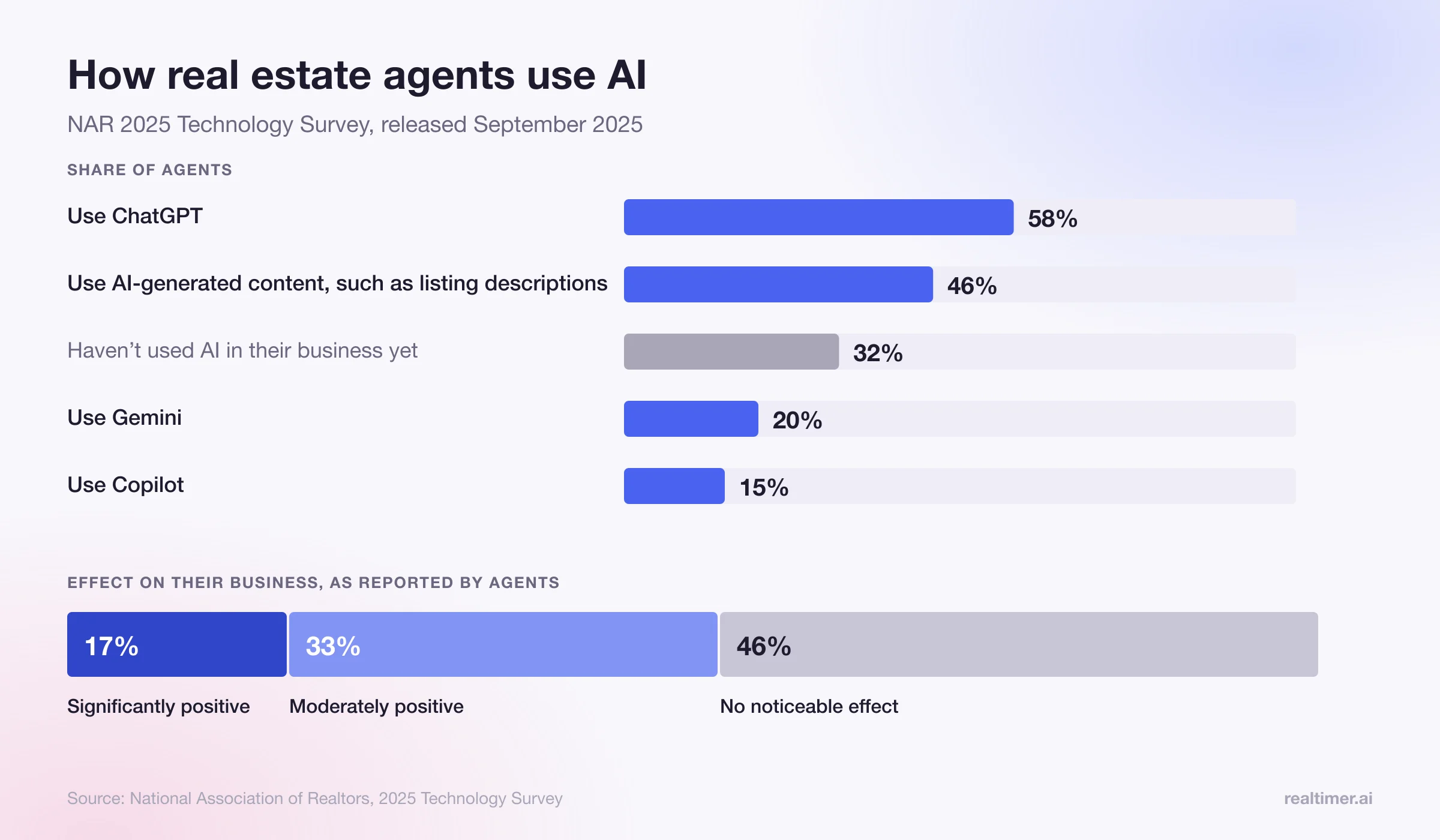
An AI assistant for real estate agents writes listing descriptions, answers and follows up leads, helps on buyer calls and showings, and turns every conversation into notes for the CRM. Most agents already use one in some form: in the National Association of Realtors’ 2025 technology survey, 46% said they use AI-generated content such as listing descriptions, and ChatGPT was the most used AI tool at 58%. Where agents get into trouble is the rules: fair housing language, disclosure of AI-edited photos, and consent for automated calls and texts.
Checked in October 2026. Survey figures come from NAR; rules come from HUD guidance, federal law and California’s AB 723, linked in the sources. This isn’t legal advice; check your state’s rules and your brokerage’s policy. We make Realtimer, one of the tools mentioned below.
How agents use AI today
NAR’s 2025 Technology Survey, released in September 2025, gives a fair picture:
| Finding | Share of agents |
|---|---|
| Use AI-generated content, such as listing descriptions | 46% |
| Use ChatGPT / Gemini / Copilot | 58% / 20% / 15% |
| Use AI daily / weekly / a few times a month | 20% / 22% / 27% |
| Haven’t used AI in their business yet | 32% |
| Report a significantly / moderately positive effect | 17% / 33% |
| Report no noticeable effect | 46% |
Almost half of the agents who use AI saw no noticeable effect. That usually means it was used for one-off tasks (a description here, an email there) instead of in the parts of the job that take the most time.
NAR’s deputy chief economist, Jessica Lautz, summed up the survey this way: “But at the heart of it all remains the trusted relationship between the agent and client.”
What an AI assistant can do for a real estate agent
| Job | What AI does | Watch out for |
|---|---|---|
| Listing descriptions and marketing | Drafts descriptions, social posts, emails and flyer copy from your notes | Wrong facts; fair housing language |
| Photos and virtual staging | Stages empty rooms, edits sky and lawn, removes clutter | Disclosure rules, such as California’s AB 723 |
| Lead response | Replies to new leads by text, chat or email within seconds, qualifies them, books showings | Consent rules for automated texts and calls |
| Buyer calls and showings | Answers questions about a unit, price, payment plan or area during the conversation | Answers must come from your documents, not guesses |
| Notes and CRM | Summarizes each call: budget, must-haves, timeline, next step | Client data privacy |
| Market and comps summaries | Summarizes recent sales and listing data you give it | AI isn’t an appraisal; check every number against the MLS |
| Transaction checklists | Lists deadlines and documents from a contract you upload | Never a substitute for the contract or a lawyer |
Listing descriptions and marketing
This is where most agents start, and it saves time from the first listing. Give the assistant the facts (beds, baths, square meters, year built, recent upgrades, what’s nearby) and ask for three versions: one for the portal, one for Instagram, one for an email to your buyer list. Then check every fact. AI likes to add a “renovated kitchen” that was last renovated in 1998.
Describe the property, not the buyer you imagine for it. The Fair Housing Act (42 U.S.C. §3604(c)) makes it unlawful to publish a housing ad that indicates a preference based on race, color, religion, sex, disability, familial status or national origin. “Perfect for young families” or “ideal for a single professional” describes people; “three bedrooms, 400 meters from the primary school” describes the home. Ask the AI to rewrite anything that describes who should live there.
Photos and virtual staging
AI staging and editing tools are cheap and fast, and they’re now regulated. California’s AB 723 took effect on January 1, 2026: brokers and agents must disclose when listing images have been digitally altered and give buyers access to the original, unaltered images. California MLS guidance treats AI virtual staging as digital alteration, and CRMLS requires the label “Some elements have been digitally added” on virtually staged photos. Other states and MLSs have their own rules; check yours before you upload an edited photo.
Lead response
Speed matters on new leads, and AI assistants answer at 2 a.m. They reply to a portal inquiry, ask about budget, area and timing, and offer showing times. That’s useful, but the rules for automated contact are strict in the US. In February 2024 the FCC ruled that AI-generated voices count as "artificial" voices under the Telephone Consumer Protection Act, so outbound calls with an AI voice generally need the person’s prior express consent. Automated texts have their own consent requirements. Keep a record of how each lead opted in. We covered the different kinds of phone AI in our guide to AI call assistants.
Buyer calls and showings
This is the part of the job where agents lose deals to “let me check and get back to you.” A buyer on a call asks the price of unit 7A on the fourth floor, the payment plan, whether the parking space is included and what the monthly fees are. If the answer takes a day, the buyer has already called another agent.
An AI assistant on calls listens to the conversation and finds the answer in your own files: the price list, the floor plans, the payment schedule, the developer’s FAQ. A generic chatbot that guesses a price does more damage than "let me check." We collected the 30 questions buyers ask on calls and the file you need ready for each.
Notes and CRM
After every call, an assistant can write the summary you’d otherwise type from memory: budget, areas, must-haves, deal breakers, timeline, and the next step with a date. Paste it into your CRM or let the tool sync it, so the second call starts where the first one ended.
Keep client data under control. Don’t paste passport numbers, bank details or anything you’d be uncomfortable seeing leaked into a general chatbot, and follow your brokerage’s policy on which tools are approved.
Market summaries and transaction checklists
AI is good at turning a table of recent sales you exported from the MLS into a readable summary for a seller. It’s bad at knowing the market by itself: a general chatbot doesn’t have current MLS data and may invent sales. Give it the data, and check the numbers it writes back.
The same goes for contracts. Uploading a signed purchase agreement and asking for a list of dates and deadlines saves time. The contract terms themselves should come from your state association’s forms and, where needed, a lawyer.
Fair housing and AI
In May 2024 HUD published guidance on how the Fair Housing Act applies to AI and algorithms in two areas.
- On advertising through digital platforms, HUD warned that ad tools “can be used to target advertising toward some consumers and away from others,” and recommended using platforms that take steps to manage the risk of discriminatory ad delivery. If you run listing ads, check how they’re targeted.
- On tenant screening, which matters to agents and property managers handling rentals, HUD said housing providers and screening companies, including those using AI, must give every applicant an equal opportunity to be evaluated on their own merit, with extra care around credit history, eviction history and criminal records.
Whatever the AI drafted, the agent is responsible for what gets published and decided.
Prompts real estate agents can copy
Replace the brackets with your own facts.
- “Write a listing description of about 120 words for [property type] in [area]: [beds] bedrooms, [baths] bathrooms, [size], [key features]. Describe the property only, not the people who might live there. No claims I haven’t listed.”
- “Rewrite this description for an Instagram caption under 60 words, with 3 short lines and no hashtags: [text].”
- “From these call notes, write a CRM summary with budget, areas, must-haves, deal breakers, timeline and next step: [notes].”
- “Here are 12 recent sales exported from the MLS: [table]. Summarize the median price per square meter, the range and days on market for a seller presentation. Don’t add any sale that isn’t in the table.”
- “From this signed contract, list every date and deadline with what has to happen by then: [contract text].”
- “A buyer from [country] asks about buying here as a foreigner. List the questions I should be ready to answer; don’t answer the legal ones yourself.”
How to start
Pick the job that costs you the most hours each week and use AI only for that for a month. For most agents it’s one of three: writing listings, answering leads fast enough, or answering buyer questions on calls. Measure one thing before and after: hours spent, response time, or how many calls end with “I’ll get back to you.”
Where Realtimer fits
Realtimer is a real-time AI assistant for calls, built with real estate agents selling new developments to international buyers in mind. It runs on your Mac and listens to the call, so it works on Zoom, Meet, Teams and WhatsApp and no bot joins. When a buyer asks about a specific unit, you press a key and see the answer from your own price list, floor plans and payment schedule in about a second, with the source. On Pro, transcription works in more than 60 languages, and you can add up to two screenshots per answer, such as a floor plan. After the call it writes notes. Pro costs €29 a month with a 7-day trial; there’s a free version with your own API keys. More on the real estate assistant page.
FAQ
What can an AI assistant do for a real estate agent?
Write listing descriptions and marketing, reply to new leads, help answer buyer questions on calls, summarize calls for the CRM, summarize market data you provide, and list contract deadlines.
How many real estate agents use AI?
In NAR’s 2025 Technology Survey, 46% of Realtors said they use AI-generated content such as listing descriptions, and 32% hadn’t used AI in their business yet.
Can I use ChatGPT to write listing descriptions?
Yes. ChatGPT was the most used AI tool in NAR’s survey, at 58%. Check every fact, and describe the property rather than the buyer you imagine, to stay within fair housing advertising rules.
Do I have to disclose AI-edited listing photos?
In California, yes: since January 1, 2026, AB 723 requires disclosure of digitally altered images, including AI virtual staging, and access to the original photos. Other states and MLSs have their own rules.
Can an AI assistant call or text my leads?
It can, but in the US outbound calls with an AI-generated voice generally need the person’s prior express consent under the FCC’s 2024 ruling, and automated texts have their own consent rules.
Is AI safe to use with client information?
Only with tools your brokerage approves. Don’t paste identity documents, bank details or other sensitive data into general chatbots.
Sources: NAR: 2025 Technology Survey; HUD: Fair Housing Act guidance on AI (2024); 42 U.S.C. §3604; SDMLS: AB 723 FAQ; The Real Deal: AB 723 takes effect; Cooley: FCC ruling on AI-generated robocalls.