AI Recruiting Assistant: What It Does at Each Stage, Tools and Rules (2026)
An AI recruiting assistant takes over the repetitive parts of hiring: finding candidates, answering their questions, booking interviews, taking interview notes and keeping the ATS up to date. Some products work as agents that do a task on their own, like LinkedIn’s Hiring Assistant sourcing candidates; others help the recruiter while they work, such as an interview assistant that keeps the question list and the CV on screen. Whatever you use one for, let the assistant prepare, organize and summarize, and keep the hiring decision with a person.
Checked in October 2026. Product facts come from vendors’ announcements and pages; survey figures from Gartner. This isn’t legal advice. We make Realtimer, a tool for recruiters mentioned once below.
What candidates think about AI in hiring
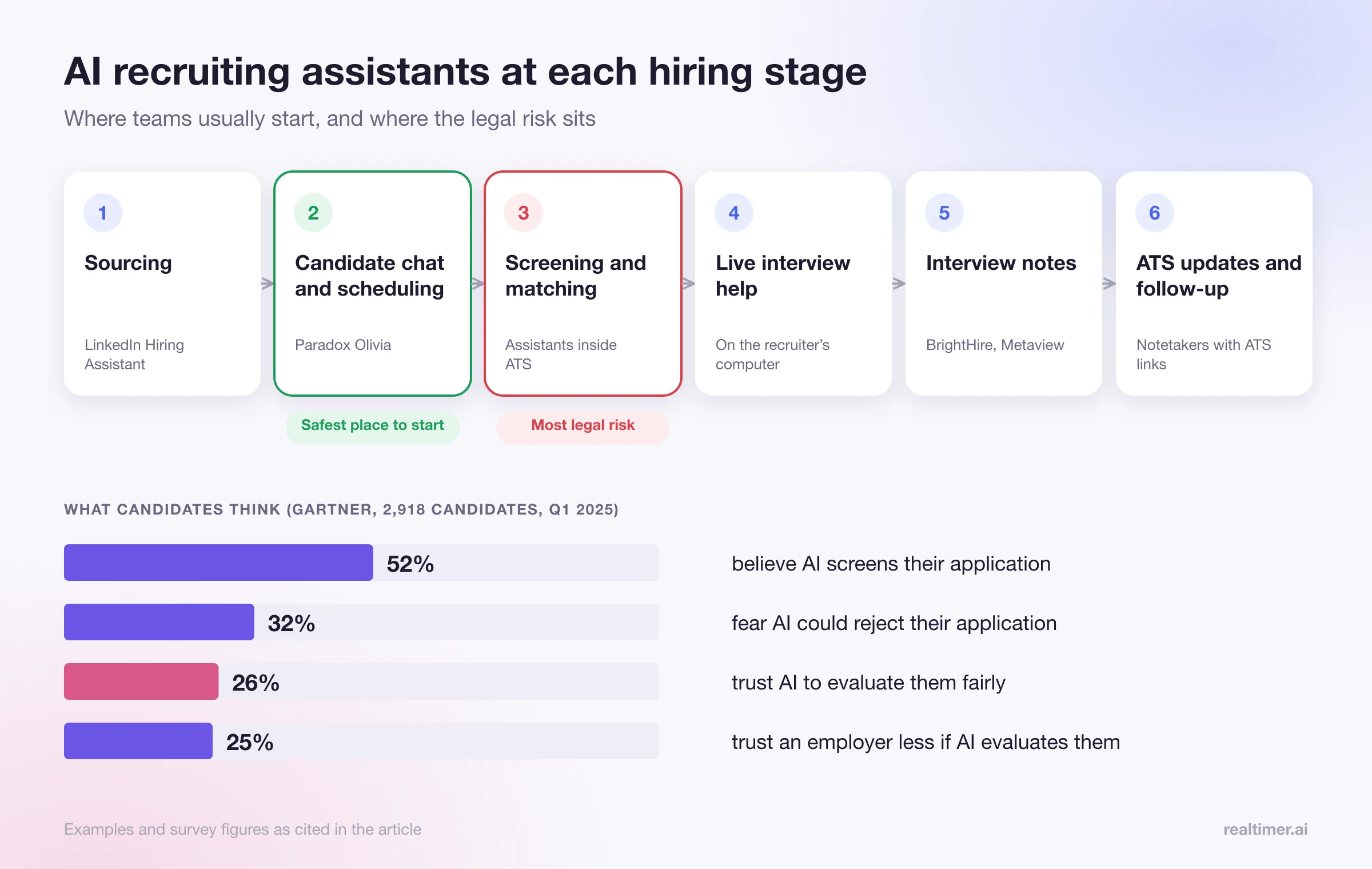
Candidates are wary of AI in hiring. Gartner surveyed 2,918 job candidates in the first quarter of 2025:
- only 26% trust AI to evaluate them fairly;
- 52% believe AI screens their application information;
- 32% fear AI could reject their application;
- 25% trust an employer less if AI is used to evaluate them.
Assistants that save the recruiter time on scheduling and notes cost little trust; a model that rejects people on its own costs a lot.
AI recruiting assistants at each stage
| Stage | What the assistant does | Examples | What to check |
|---|---|---|---|
| Sourcing | Searches profiles from a description of the role, suggests candidates, drafts outreach | LinkedIn Hiring Assistant | Whether the shortlist is diverse and explainable |
| Candidate questions and scheduling | Answers candidates by chat or text, collects details, books interviews | Paradox Olivia (now part of Workday) | Handover to a person; what it says about salary and status |
| Screening and matching | Ranks applicants against the job, flags gaps | Assistants inside ATS platforms | Bias audits; whether a recruiter reviews every rejection |
| Interview, live | Shows the CV and question list, notes answers, flags gaps against the CV | Interview assistants that run on the recruiter’s computer | No emotion analysis; consent to transcribe |
| Interview notes | Transcribes the interview, writes notes and a summary for the hiring manager | BrightHire, Metaview, general notetakers | Bot or no bot; where recordings are stored |
| ATS updates and follow-up | Writes notes into the ATS, drafts follow-up and rejection emails | Notetakers with ATS integrations | Tone and accuracy of rejections |
Sourcing agents
LinkedIn’s Hiring Assistant is the best-known example. LinkedIn first released it to a group of charter customers in October 2024 and announced it would be globally available in English by the end of September 2025. Recruiters describe the role in plain language, and the assistant builds a list of qualified candidates, helps with outreach and handles some admin. LinkedIn says recruiters can see and step into the assistant’s actions at any stage, and it’s sold as an add-on to LinkedIn Recruiter.
It’s good for the first draft of a long list. Keep an eye on what it learns: a sourcing agent learns from what you accept and reject, so check that the shortlists don’t narrow to the same school, company or profile every time.
Candidate chat and scheduling
High-volume hiring (retail, hospitality, logistics) uses conversational assistants that answer candidates’ questions, collect basic details and book interviews by text or chat. Paradox’s Olivia is the leader here; Workday completed its acquisition of Paradox on October 1, 2025, adding it to Workday’s recruiting products alongside HiredScore.
This is usually the safest place to start, because the assistant handles logistics and makes no judgment about the candidate. Check what it says when a candidate asks something it shouldn’t answer, such as salary for a role with no published band, or why they weren’t selected.
Screening and matching
Most ATS platforms now rank applicants against the job description. This is the stage with the most legal risk: New York City requires a bias audit for automated employment decision tools, Illinois bans AI that discriminates and requires notice, and the EU will treat screening AI as high risk from December 2, 2027. We summarized those rules in our guide to AI for recruitment. The practical minimum: a person reviews every rejection, and you can explain why someone ranked where they did.
Interview notetakers
Interview intelligence tools record and transcribe the interview, then write notes and a candidate summary tied to the moments in the conversation. BrightHire is one of the established names; Zoom announced in November 2025 that it would acquire it. Metaview offers AI interview notes that work with existing ATS and CRM tools.
Two decisions come with any notetaker. First, whether a bot joins the call: on a first interview, an unfamiliar participant in the list can unsettle a candidate. Second, consent: tell the candidate the interview is transcribed and why, before you start.
Live interview assistants
A newer kind of tool, the AI call assistant, helps the recruiter during the interview itself. While the candidate talks, the assistant shows the candidate’s CV and your question list next to the call, notes the answers as they come, and flags when an answer doesn’t match the CV. It can also answer the candidate’s own questions about the role from your job description, so you don’t promise a benefit or a salary the company hasn’t approved.
This helps with structure. A large meta-analysis by Schmidt and Hunter (1998) found structured interviews predicted job performance better than unstructured ones (validity of 0.51 against 0.38). An assistant that keeps you on the same questions for every candidate makes it easier to run a structured interview without reading from a sheet.
What not to let an AI recruiting assistant do
- Decide alone. Keep a person on every rejection and every offer.
- Analyze emotions. The EU AI Act has banned emotion recognition in the workplace since February 2, 2025, and the Commission’s guidance includes job candidates. A tool that reads a candidate’s face for “enthusiasm” is off the table in the EU, and a bad idea elsewhere.
- Score without an audit. If it ranks or scores candidates, ask for the bias audit and test it on a past hiring round.
- Speak for the company without a source. A candidate chatbot that improvises on salary, remote work or visa sponsorship creates promises you’ll have to break.
- Keep data forever. Set how long transcripts and recordings are kept, and who can see them.
Candidate fraud and AI
Candidates use AI too. Gartner expects that by 2028 about one in four candidate profiles worldwide could be fake, and in a survey of 3,290 candidates, 39% said they had used AI during the application process. Interview assistants that compare answers with the CV help here too: a candidate whose answers drift from their own CV is worth a follow-up question. We wrote a separate guide on spotting hidden AI help in interviews.
How to choose an AI recruiting assistant
Ask every vendor:
- Which stage does it cover, and does it decide anything on its own?
- What does the candidate see: a bot in the call, a chatbot, a notice?
- Where are recordings and transcripts stored, for how long, and are they used to train models?
- Has it been audited for bias, and can you see the results?
- Does it write into your ATS, or will someone copy notes by hand?
- Can one recruiter try it on real interviews this week?
Then start with one stage. For most teams that’s scheduling or interview notes, which take many hours and carry little risk.
An interview assistant for recruiters on Mac
Realtimer is a real-time assistant for interviews and other calls. It runs on the recruiter’s Mac and listens to the call there, so no bot joins Zoom, Meet or Teams. It shows the candidate’s CV and your question list during the interview, answers the candidate’s questions about the role from your own job description and company documents, and writes notes after the call. It doesn’t rank or score candidates; the decision stays with you. More on the recruiting assistant page.
FAQ
What is an AI recruiting assistant?
Software that handles repetitive hiring tasks: sourcing candidates, answering their questions, scheduling interviews, taking interview notes and updating the ATS. Some work as agents on their own; others help the recruiter during the work.
What is LinkedIn Hiring Assistant?
LinkedIn’s AI agent for recruiters. It builds candidate lists from a plain-language description of the role and helps with outreach and admin. It’s sold as an add-on to LinkedIn Recruiter, and LinkedIn says recruiters can see and intervene in its actions.
Can an AI recruiting assistant interview candidates?
Some tools run one-way video or chat screens, but the safer use is helping the human interviewer: showing the CV and questions, taking notes, and checking answers against the CV.
Do candidates trust AI in hiring?
Not much yet. In Gartner’s 2025 survey, only 26% of candidates trusted AI to evaluate them fairly, and 25% said they trust an employer less if AI evaluates them.
Is it legal to use AI in recruiting?
Yes, with conditions in some places: bias audits and notice in New York City, notice and no discriminatory AI in Illinois, and high-risk duties in the EU from December 2027. Emotion recognition on candidates is banned in the EU.
Should the AI tell candidates it’s there?
Yes. Tell candidates when an interview is transcribed and when AI is part of the process; it’s required in several places and it protects trust everywhere.
Sources: Gartner: 26% of candidates trust AI; LinkedIn: Hiring Assistant global launch; LinkedIn: Hiring Assistant; Workday: completes Paradox acquisition; Zoom: acquires BrightHire; metaview.ai; Schmidt and Hunter (1998), Psychological Bulletin; HR Dive: Gartner on fake candidates.